Greek Music and Dance Traditions

Illustrative studio scene; it is not associated with a specific historical performer.
A 1928 New York recording by Marika Papagika places Greek music in an American city long before today’s festival stages. Her “Smyrneikos Balos” links a performer’s immigrant career with a dance form shaped by the cosmopolitan music culture of Smyrna.
Music moved with people and changed in America
About two thousand Greek recordings appeared in the United States between 1896 and 1942. Commercial records brought Greek performers into American studios and carried songs to listeners far from the places where a style had developed.
Greek American performers made music for a public audience as well as for private gatherings. Songs circulated through immigrant communities, clubs, cafes, and family celebrations; music made in the United States also reached listeners in Greece and other diaspora communities.
Papagika was born on the island of Kos and moved to New York with her musician husband in 1915. She became a prominent Greek American recording artist. The 1928 “Smyrneikos Balos” draws on Smyrneika, a style shaped in the multiethnic urban culture of Smyrna before the city’s destruction and the displacement of its Greek population.
Regional sound resists a single template
Greek musical traditions vary in rhythm, style, instrumentation, language, and social purpose. A song from an island community may sound different from music shaped by mainland traditions or by the Greek communities of Asia Minor. Pontian music carries a distinct regional identity connected to the Black Sea. Urban repertories also developed through contact among Greeks, Turks, Jews, Armenians, and other peoples.
Smyrneika developed in Smyrna’s cosmopolitan urban culture, where musicians and audiences crossed community lines. The destruction of the city in 1922 and the displacement that followed carried these repertoires into Greece and the diaspora. Music preserved sounds associated with a lost place while continuing to change in new communities.
Greek Orthodox chant belongs to a different setting from popular folk music. Byzantine chant is part of liturgical worship. A dance tune at a festival serves social and celebratory purposes. Both may appear in a Greek American community, but they do not have the same function or musical structure.
Dance makes music social
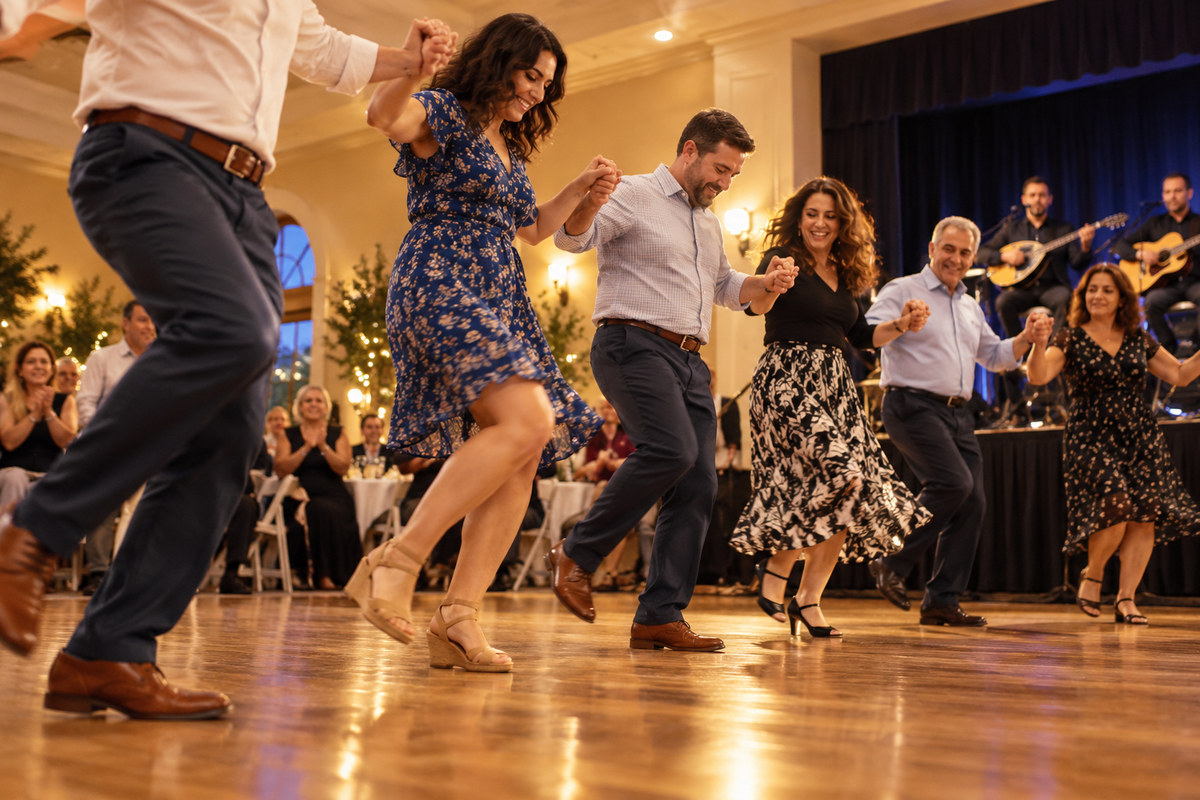
Many Greek community dances are performed in a line or circle, often with dancers holding hands or linking arms. The form can make the group more visible than a solo performer: participants follow a shared pattern, while the lead dancer may have room for variation. A celebration can include familiar pan-Hellenic dances alongside regional forms tied to a family’s ancestry.
The balos is a couples’ dance whose light, quick, smooth steps vary among the islands. In Greek American settings, it appears alongside forms such as the Kalamatianos, with each dance carrying its own rhythm, pattern, and regional associations.
Dance can function as social knowledge. A child learns where to stand, when to follow, how to keep a rhythm, and how to respond to other dancers. A church school performance may present a choreographed selection for an audience. A family celebration may invite guests into a less formal circle. The same tradition can look different across these settings.
A dance tune may alternate a sung verse with instrumental passages that give dancers room to turn or change formation. A singer can stretch a line while the ensemble holds the pulse. That exchange links melody and movement, so a dance is not merely an accompaniment to the music.
In a circle dance, the pattern lets newcomers join by watching the dancers ahead of them. A leader sets the sequence while the group keeps a shared pulse. In a couples’ dance, the space between partners brings the musical phrasing into view. The form of participation can be recognized even by someone who does not know the name of a particular step.
| Dimension | Variation | Context |
|---|---|---|
| Regional origin | Island, mainland region, Pontus, Smyrna, or diaspora setting | Regional identity prevents a performance from becoming “all Greek music.” |
| Performance setting | Church service, festival, wedding, classroom, recording, or concert | Setting clarifies whether the music is liturgical, social, educational, or commercial. |
| Participants | Professional musicians, students, family members, dancers, or congregation | Participation can reveal how a tradition is taught and shared. |
| Performance details | Performer, place, instruments, song, and occasion | These details connect sound with a particular community. |
Instruments and performance settings
Greek music uses a variety of instruments across regions and styles. Bowed strings, plucked strings, percussion, wind instruments, and voice appear in different combinations. A santouri player photographed in Illinois stands among other Greek American performers associated with fiddle, cymbal, mandola, and voice. The combination changes with the region and the musicians.
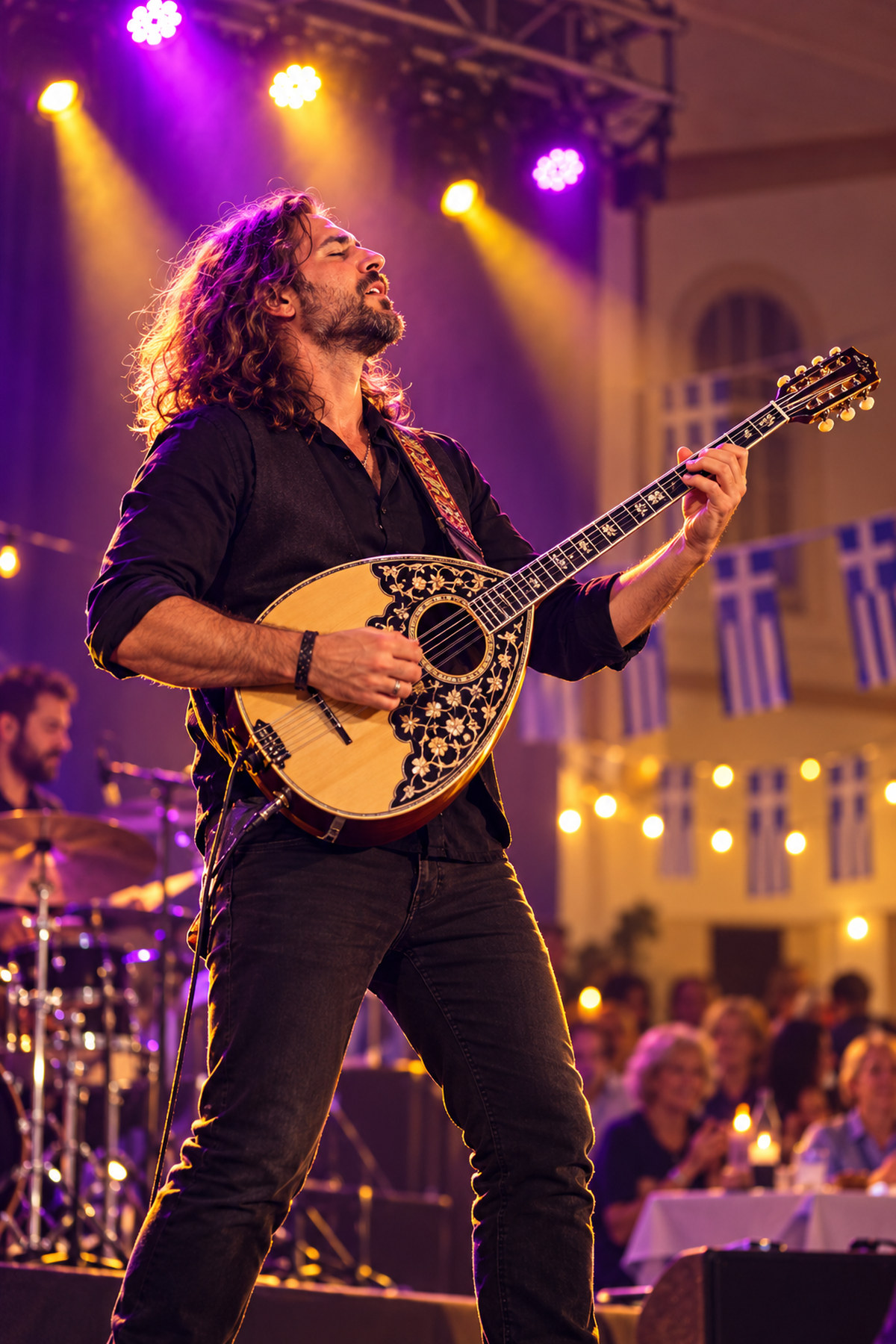
A santouri, lyra, fiddle, or bouzouki carries a different timbre and technique. A performance’s sound depends on how instruments meet the singer’s phrasing and the dancers’ rhythm, not on a single instrument standing for all Greek music.
An ensemble’s balance shapes a song. The singer’s phrasing may lead an instrumental line; percussion keeps a pulse while strings answer or double the melody. A small group creates a different texture from a festival band amplified for a large outdoor crowd. The size of a room and the distance between musicians and dancers also affect that balance.
Rhythm becomes physical through a phrase’s turn, the placement of each step, and a partner’s timing.
No single instrument represents every Greek musical tradition. The bouzouki is closely associated with popular music and rebetiko, while the lyra or santouri may lead other regional styles. Musicians adjust arrangements to the venue, audience, and performance format.
Home gatherings, church events, restaurants, school programs, and staged festivals each give music a different role. Amplification, choreography, costume, and set length shape what listeners hear, while the people in the room determine whether a song becomes a performance, a dance, or a shared celebration.
Parishes and cultural groups keep repertories active
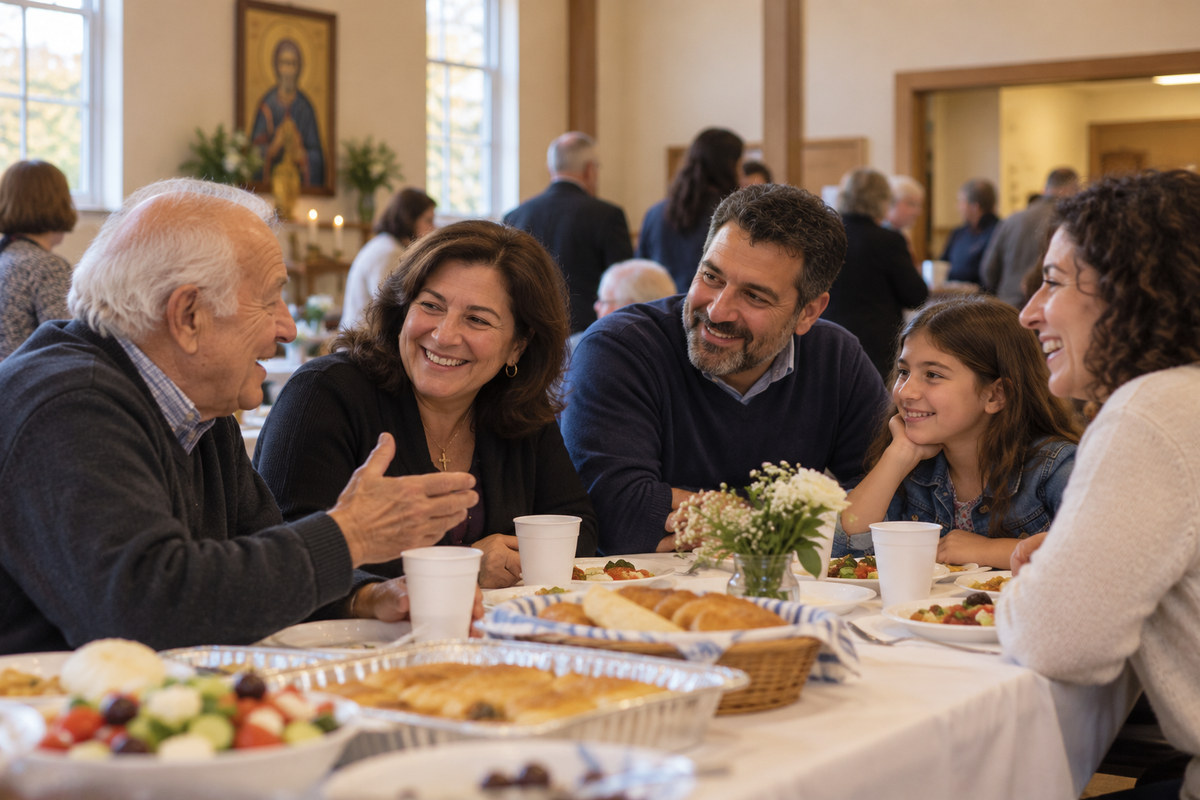
Greek-language schools, parish groups, and cultural societies give music and dance a place in community life. A school performance can introduce children to regional names and basic steps; a festival band brings familiar forms to a wider audience.
Regional dance groups bring their own movement vocabularies to Greek American stages. A Pontian dance, an island balos, and a mainland line dance do not share one rhythm or social history. The region attached to a dance matters as much as the costume or the number of performers.
For Greek American children, a performance may be the first introduction to a regional dance. Adults may recognize the music through a relative’s hometown or a recording heard at home. Newcomers can encounter the repertoire through a public festival. These routes into the tradition can coexist without making one form of participation more authentic than another.
Recordings carry music into new settings
The recording preserves a particular arrangement but leaves out the dancers and room around them. On a live floor, people’s steps and the band’s phrasing respond to one another in ways a recorded track cannot show.
In a live performance, dancers make the rhythm visible through spacing, turns, and changes of pace. A family gathering invites a different relationship between performers and listeners than a concert stage, even when both use the same song. The repertoire stays recognizable while the occasion shapes how people participate.
Common Questions
What are the most widespread regional Greek circle dances?
The Kalamatianos in 7/8 rhythm, the graceful Syrtos, the heroic Tsamiko, and Pontian dances such as the Tik and Serra, each tied to regional villages and historical memory.
How did 78 RPM recordings influence Greek-American music?
Early Greek immigrant musicians recorded regional songs in New York and Chicago studios during the 1920s-1950s, preserving island and mainland tunes that became staples across American parishes.